
For years, Miami homeowners have suspected that our mold problem is worse than the national average. Now, we have the data to prove it. According to the latest environmental hazard reports released by the National Mold Index, Miami-Dade County has been categorized as a “Severe Risk” zone for indoor microbial growth.
This designation is not given lightly. The National Mold Index aggregates data on humidity levels, average rainfall, building material density, and historical insurance claims to calculate a risk score for every US zip code. Miami’s score is currently among the highest in the nation.
A “Severe” rating indicates that the ambient environmental conditions (humidity above 70% year-round) are sufficient to support mold growth without a plumbing leak. In Miami, your home doesn’t need to flood to grow mold; it just needs to exist.
1. Visualizing the Threat: The Miami Mold Risk Map
The following map illustrates the density of “high-risk” environmental zones across the Greater Miami area. As you can see, the risk is not isolated to the coast; it permeates inland due to the “Heat Island Effect” and trapped humidity.
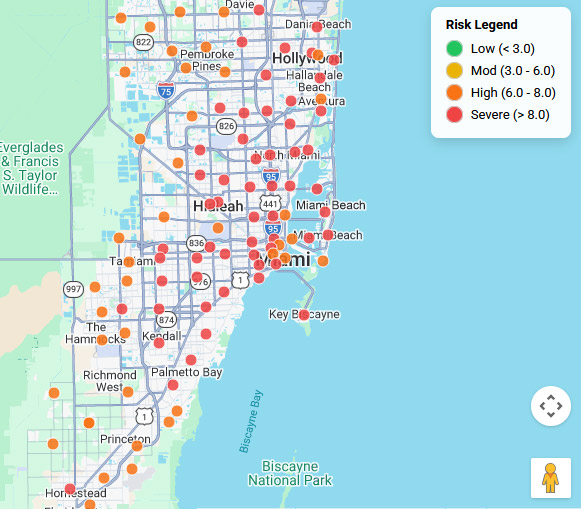
Key Takeaways from the Map:
- The “Red Zone”: Almost the entire metropolitan area falls into the highest risk category.
- Coastal Vulnerability: Areas like Miami Beach and Brickell face a double threat: atmospheric humidity plus salt-air corrosion, which degrades building seals.
- Inland Traps: Areas west of I-95 (like Doral and Hialeah) often see higher fungal counts because the sea breeze does not penetrate deep enough to clear the stagnant humid air.
2. Why Did Miami Score So Poorly?
The National Mold Index methodology points to three specific factors that make Miami uniquely dangerous for indoor air quality:
A. The “Dew Point” Factor
Mold does not need standing water; it needs a “dew point” interaction. In Miami, the outdoor dew point is often 75°F. If you keep your AC at 72°F, your walls are colder than the air outside. This causes moisture to migrate through the concrete and condense on the back of your drywall.
B. Aging Infrastructure
Many Miami homes built in the 1970s and 80s utilize “stucco on block” construction. Over 40 years, stucco develops micro-cracks. In a “Severe Risk” zone, these cracks allow humidity to bypass the building envelope, saturating the insulation.
C. Hurricane History
The Index notes that repeated exposure to tropical storms (even minor ones) creates a “cumulative moisture load.” A home that got wet in 2017 (Irma) and wasn’t perfectly dried is now a prime candidate for a massive bloom in 2026.
3. How to Survive in a Severe Risk Zone
Living in a “Red Zone” on the National Mold Index map does not mean your home is doomed. It means you must be proactive rather than reactive.
- Monitor Your Humidity: Do not guess. Install digital hygrometers in every room. If the reading stays above 60% for more than 48 hours, you have a problem.
- Upgrade AC Filtration: Use MERV-11 or higher filters to trap spores before they circulate.
- Annual Inspections: In a severe risk zone, an annual mold inspection is as important as a termite inspection.
Frequently Asked Questions
The National Mold Index is a data resource that aggregates climate data, housing age, and water damage statistics to rate the likelihood of mold growth in specific geographic regions.
No. While the risk is severe, mold is preventable. Homes with proper waterproofing, correctly sized air conditioning, and humidity control can remain mold-free even in the highest risk zones.
The map represents statistical probabilities based on environmental data. It shows that homes in Miami are under constant moisture pressure, meaning small maintenance failures (like a leaky window) result in mold much faster here than in other parts of the country.
Are You Living in the Red Zone?
The map shows the risk is real. Don’t wait for the smell to start. Our team uses the same detection standards as the experts to keep your home safe.
Verify Your Home’s Safety: +1 305-239-8744
Serving High-Risk Zones in Miami-Dade